Throughout history, people have been fascinated with predicting the future. Almost anything could become an object of divination in the right hands, used to foretell everything from the weather and the harvest to love, marriage, money and death.
Cards were shuffled. Palms were read. Dreams were interpreted. The movements of the stars were watched carefully overhead.
And sometimes, the future was found at the bottom of a cup of tea.
Tea-leaf reading has gathered almost as many names as it has traditions. It is variously known as cup reading, cup tossing, tasseography, tasseology and tasseomancy — the latter combining the French tasse, meaning cup, with the language of divination.
Exactly where the practice began is harder to pin down.
Some histories trace it to China, where tea drinking has a far longer history than it does in Britain. Others suggest that similar methods of divination may already have been practised in Scotland, Ireland and England using herbal infusions, before imported Chinese tea became widely available.
Like so many pieces of folk magic, its beginnings become rather hazy the further back you look.
What we do know is that by the nineteenth century, reading the leaves left behind in a cup was already sufficiently familiar to be spoken about as an old tradition.
In 1899, the American writer John Hanley described tea-leaf figures and signs as they had been interpreted by “our grandmothers” — a lovely little phrase which suggests that even then, knowledge of the cup was thought of as something inherited from the women who came before.
Women, Tea and a Little Magic
The history of tea-leaf reading is, in many ways, also a history of women.
Tea occupied a particularly domestic and social world. It was brewed in kitchens and drawing rooms, poured between mothers and daughters, sisters, friends and neighbours.
And within that most ordinary of rituals there was room for a little magic.
The leaves left clinging to the china could become ships and horses, hearts and crosses, birds and trees. Their position inside the cup mattered too. The handle represented home, while the opposite side could represent the world beyond it. Signs close to the rim might concern the immediate future, while those further down the cup could belong to events still some distance away.
Even an inconvenient piece of stalk had something to say.
Known as the Stranger, a stray tea stem could foretell the arrival of a visitor. For an unmarried young woman, that stranger might even be a future husband.
The last stubborn drop of tea could have a purpose too. Sometimes called the Love Drop, it could be tipped into the saucer and consulted separately on matters of the heart.
Nothing in the cup needed to go to waste.
Not even the dregs.
From the Kitchen Table to the Tearoom
By the beginning of the twentieth century, tea-leaf reading had begun to move beyond the home.
Women entrepreneurs opened tearooms: small, comfortable establishments serving tea, light lunches and non-alcoholic drinks. Particularly during the years between the two World Wars, some added something rather more unusual to the menu.
A customer might finish her lunch and have her cup read by a waitress, or find palmistry and crystal gazing offered alongside the tea leaves.
There is a less charming side to this history. Some establishments dressed their fortune tellers in stereotyped costumes and advertised them as “Gypsy” readers, borrowing a romanticised and often invented version of Roma culture to give their readings an air of mystery.
But beneath the theatrical trappings was something interesting.
Women had taken something associated with the domestic sphere — making tea, serving food, sitting together and talking — and turned it into businesses and social spaces of their own.
And somewhere along the way, the china manufacturers realised that they could put the fortune telling directly into the cup.
When the Teacup Learned to Tell Fortunes
By the early twentieth century, specially designed fortune-telling cups were being produced to help their owners interpret what the leaves had to say.
Some were printed with signs of the zodiac and other astrological symbols. Others contained familiar omens: anchors, horseshoes, birds, snakes and other tiny images waiting for a tea leaf to land upon them.
Others combined tea-leaf reading with another old method of divination.
Playing cards.
Which brings me to mine.
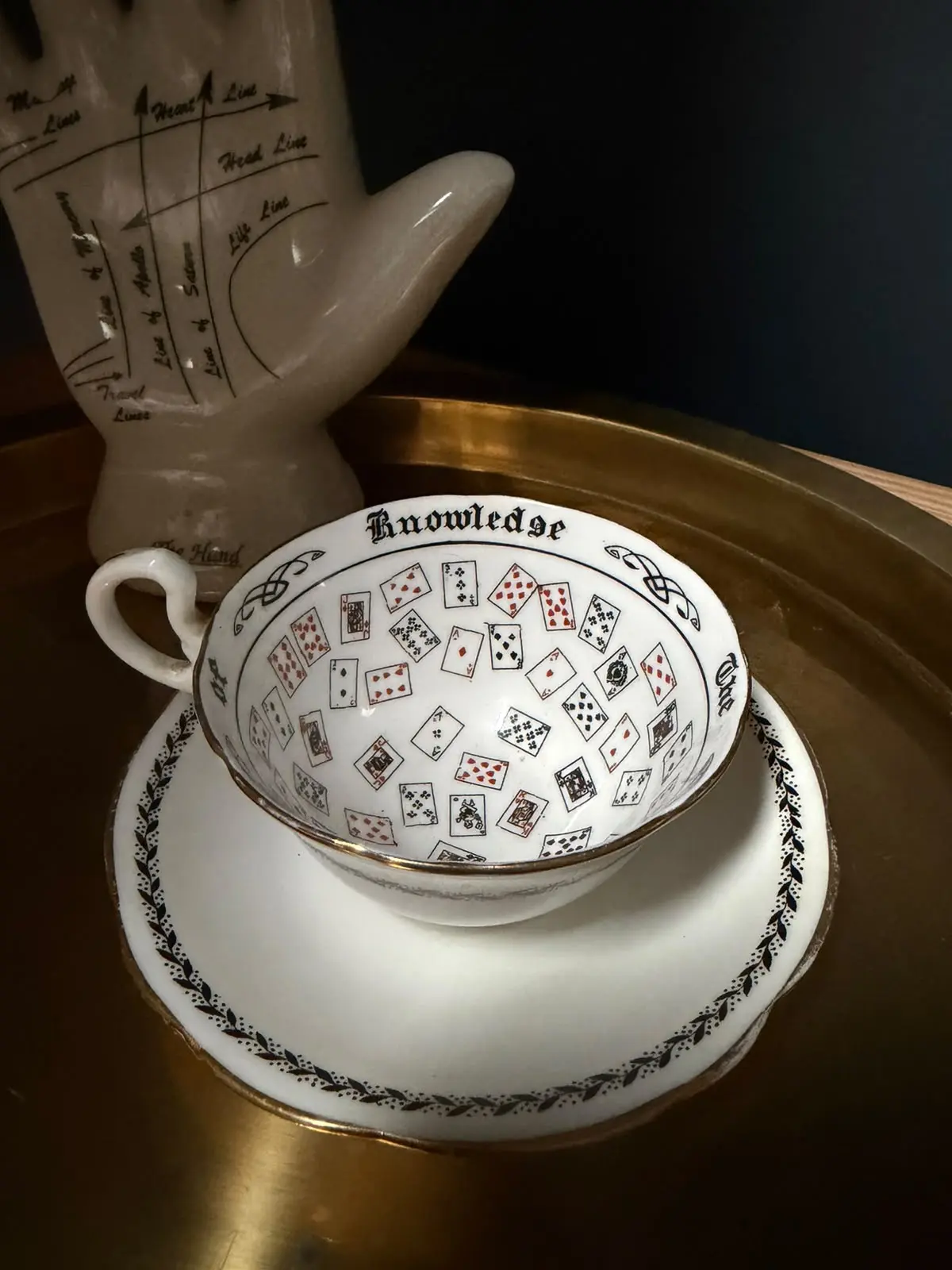
The Cup of Knowledge.
My Cup of Knowledge was given to me by my mum many years ago.
I have lovingly kept it ever since, although until recently I had never really stopped to consider the history behind this curious little object.
Turn it over and there is a clue.
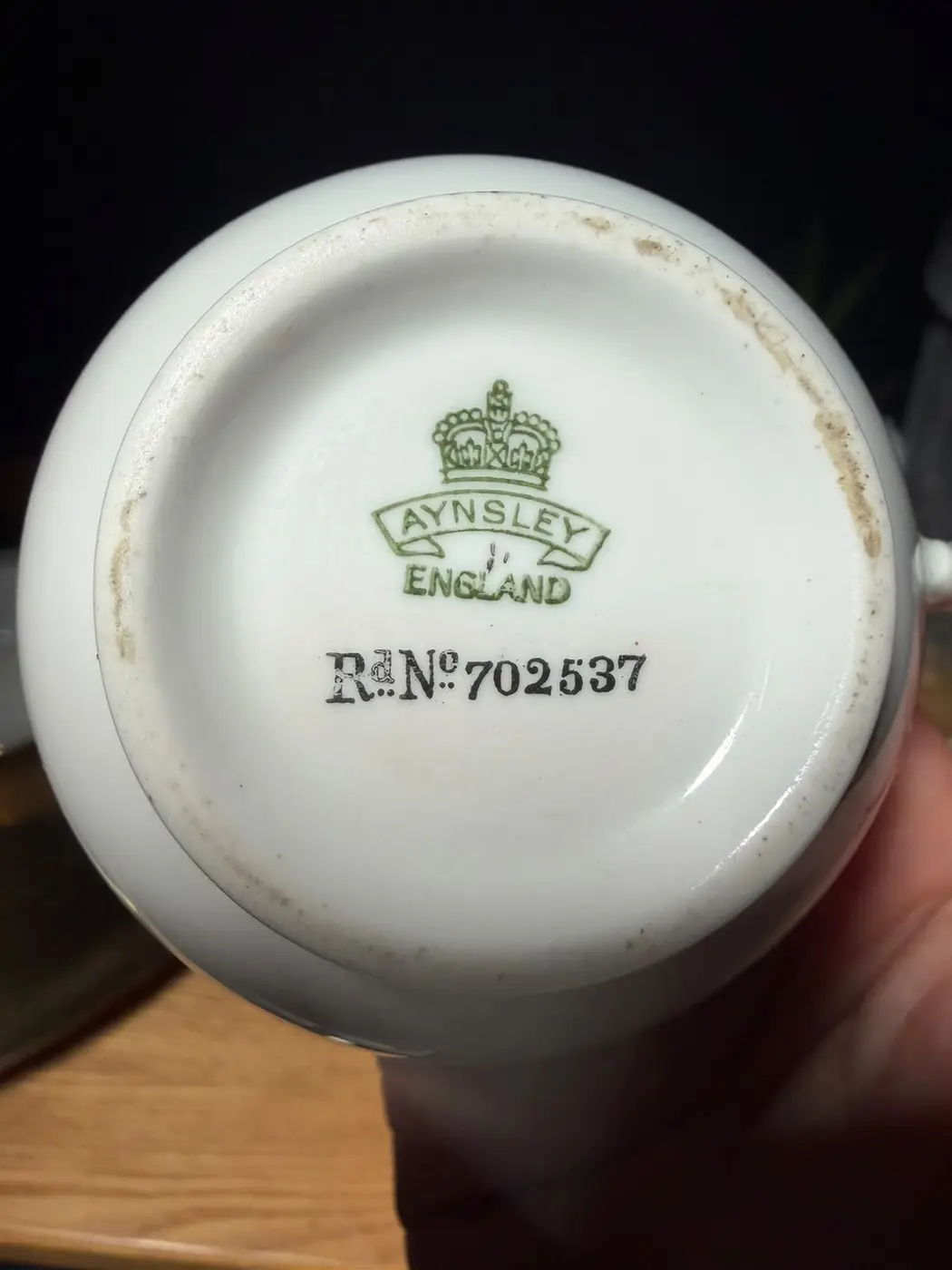
On the base is the green crown mark of the English china manufacturer Aynsley. Beneath it is another mark:
Rd. No. 702537.
The same registered design number appears on an Aynsley Cup of Knowledge held today in the collection of the Museum of Witchcraft and Magic in Boscastle.
Dating from the 1920s, the design brings together two forms of divination: reading the remnants of a cup of tea and cartomancy — fortune telling with playing cards.
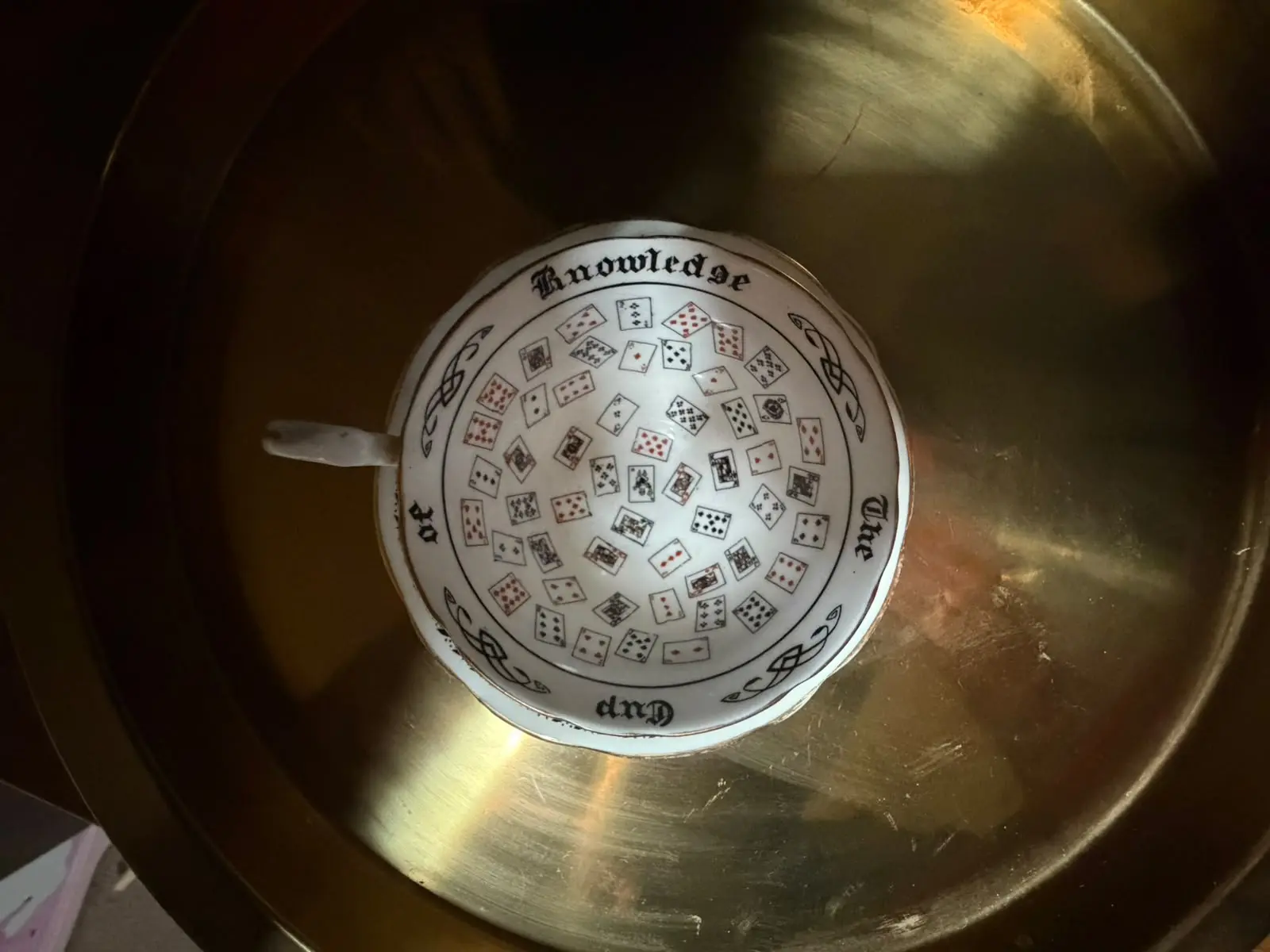
Look inside and an entire deck of fifty-two tiny cards has been scattered across the china in red and black, while around the rim, in gothic lettering, are the words: The Cup of Knowledge.
It is an extraordinary name for such a small and delicate thing.
The cups were originally accompanied by a guide explaining how their fortunes should be read. Its writers apparently anticipated that not everyone would take the idea entirely seriously. One surviving passage begins:
Which makes me rather fond of whoever wrote it.
After all, the Cup of Knowledge is not an imposing magical object.
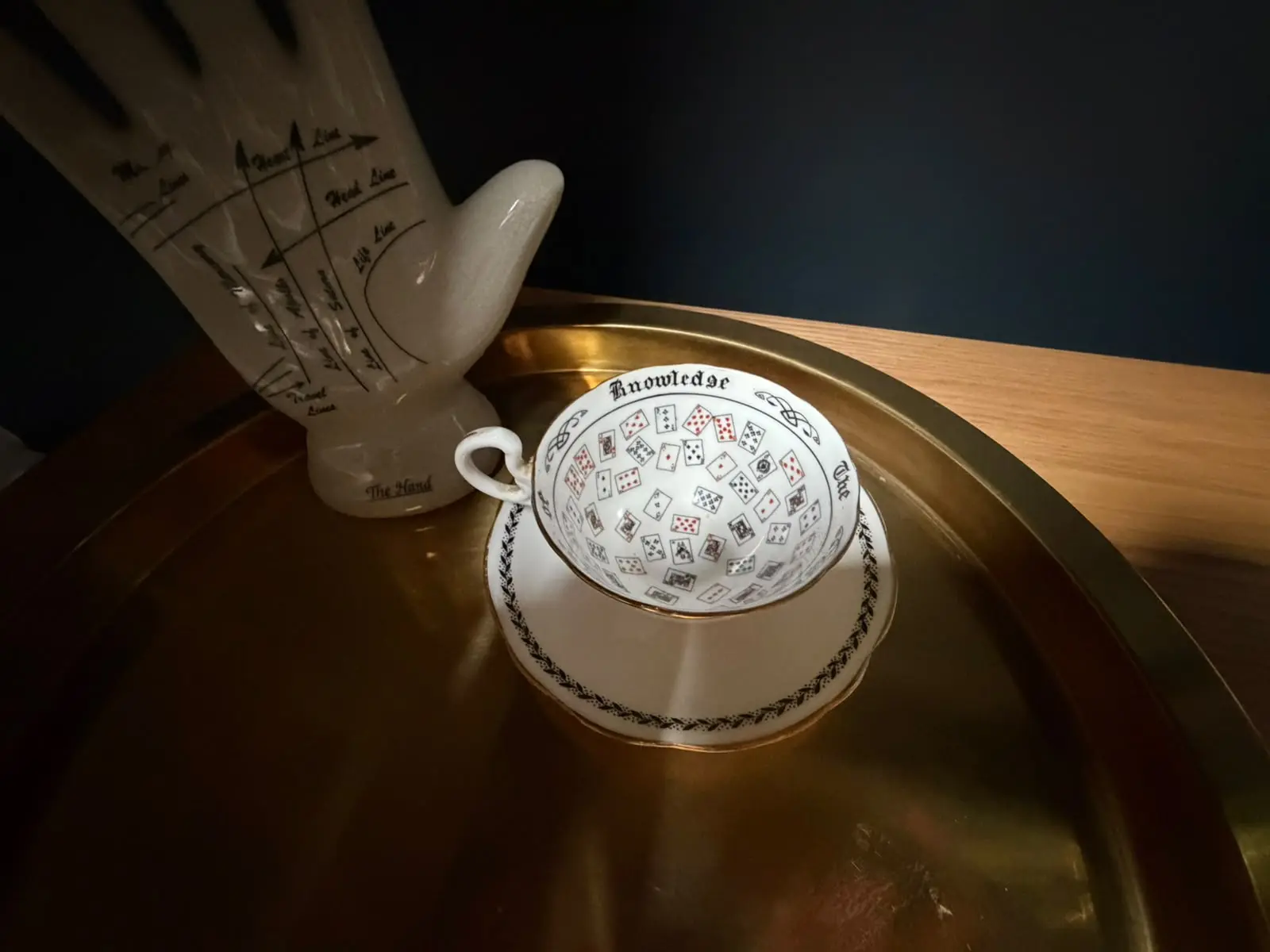
It is delicate English china. Mine has a little gold handle, a gilded rim and a matching saucer. It looks as though it ought to contain a perfectly respectable cup of tea.
And yet somebody covered the inside with playing cards and invited its owner to consult it about the future.
That contradiction is precisely what I love about it.
From Her Hands to Mine
There is another reason I have become so fascinated with the history of this particular cup.
Mine came from my mum.
The Cup of Knowledge belongs to a much bigger story of women, tea and fortune telling: of grandmothers interpreting the leaves, women reading cups around kitchen tables, fortune tellers earning money in interwar tearooms and friends wondering together about love, journeys and whatever might be waiting around the corner.
And somehow, a century after cups like mine first appeared, one has found its way from my mum’s hands into mine.
Perhaps that is what I like most about old domestic objects.
Their histories aren’t confined to museums or books. They survive because people keep them. They sit on shelves and in cupboards, are packed into boxes when houses are moved, and sometimes pass quietly from one generation to another without anybody stopping to wonder where they came from.
Until one day, somebody does.
I don’t know what fortunes have been read from my Cup of Knowledge over its lifetime, or how many cups of tea have been drunk from it.
I don’t know whether any of its predictions came true.
But I like knowing that it has survived.
And I particularly like that an object rooted in a tradition so closely associated with women has reached me through one of the women in my own life.
So perhaps one day I’ll brew some loose-leaf tea, take the old cup down from its shelf and ask it a question of my own.
After all, it has been keeping people’s secrets for around a century.
Perhaps it knows something.
What tea will it spill for me?